07 · Your First Trade: The Complete Flow from Account Setup to Order Placement
The previous six articles covered what markets are, what the terms mean, how to read charts, how orders work, and how to manage position sizing. This one ties it all into a single thread: completing your first cryptocurrency trade from scratch.
Disclaimer: all content on this site is for learning and research only and does not constitute investment advice. Markets carry risk; invest with caution.
1. Choosing a Trading Platform
1.1 Key Considerations
| Dimension | What to check |
|---|---|
| Security | Any past hacks? Cold wallet ratio? Insurance fund? |
| Liquidity | Daily trading volume? Tight spread? Enough depth? |
| Fees | Maker/Taker rates? VIP tier discounts? |
| Compliance | Legally operating in your jurisdiction? |
| User experience | Clear interface? Responsive support? |
1.2 Mainstream Platforms at a Glance
| Platform | Strengths | Best for |
|---|---|---|
| Binance | Largest globally, best liquidity, widest coin selection | Traders with some experience |
| OKX | Full-featured, rich derivatives tooling | Derivatives traders |
| Coinbase | Compliance-friendly, clean interface, top pick for US users | US/European beginners |
| Bybit | Derivatives roots, strong mobile experience | Derivatives / mobile users |
⚠️ Platform Risk
An exchange is a centralized institution — "not your keys, not your coins". Move large holdings to a self-custody wallet. Platforms can suffer hacks, regulatory freezes, or mismanagement.
2. Registration and Deposit
2.1 KYC (Know Your Customer)
Nearly all compliant platforms require identity verification:
1. Register with email/phone number
2. Upload an ID document (ID card/passport)
3. Facial recognition
4. Wait for review (minutes to days)
Higher KYC tiers unlock larger deposit and withdrawal limits.
2.2 Deposit Methods
| Method | Arrival time | Fees | Barrier |
|---|---|---|---|
| Bank/credit card purchase | Minutes | Higher (2%–5%) | Lowest |
| P2P (over-the-counter) | Varies | Low/free | Medium |
| On-chain transfer (from another wallet) | Minutes to hours | On-chain gas fees | Requires existing crypto |
| Internal transfer (same platform) | Instant | Free | Both parties on the same platform |
3. Reading the Trading Screen
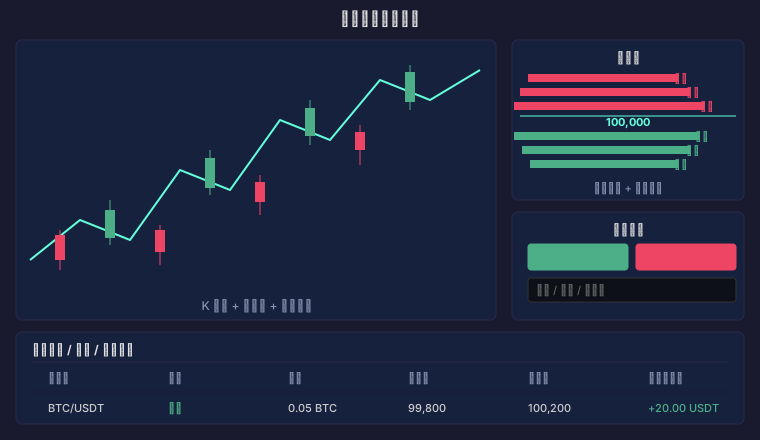
Taking Kline Buty or Binance as the example, a typical spot trading page has four zones:
| Zone | Contents |
|---|---|
| Left / center | Candlestick chart + volume + indicators |
| Upper right | Order book (bid/ask ladder + depth chart) |
| Lower right | Order panel (buy/sell buttons + price/quantity inputs) |
| Bottom | Current positions / open orders / trade history |
Key Fields at a Glance
- Last price: the price of the most recent trade
- 24h change: percentage change versus 24 hours ago
- 24h high/low: highest/lowest price over the past 24 hours
- 24h volume: how many BTC (or USDT) traded over the past 24 hours
4. Your First Trade
Step 1: Pick the Pair
Type BTC in the search bar and select the BTC/USDT pair. USDT is a USD-pegged stablecoin — effectively the "cash" of the crypto market.
Step 2: Decide the Buy Amount
💡 A Note on the First Trade
Keep the first buy within an amount you can afford to lose entirely — say the equivalent of 100–500 yuan. Not because you will probably lose it all, but because the psychological cost of small-scale trial and error is the lowest: you can walk through the entire flow without emotional pressure.
Step 3: Place the Order
Order type: limit
Price: enter 99% of the current market price (1% below market — practice waiting for a fill)
Quantity: the amount of BTC you want to buy (or click a percentage button, e.g. 25%)
Side: buy

→ Click the "Buy BTC" button
If price doesn't pull back to your limit, the order sits in "open orders" waiting.
Step 4: Set Take-Profit and Stop-Loss
Right after the fill, do two things:
Stop-loss order: price = entry price × 95% (max 5% loss)
Take-profit order: price = entry price × 110% (exit at +10%)
Bind the two orders together with an OCO
Step 5: Monitor and Exit
- Price hits the stop-loss or take-profit → auto-fill → done
- You decide to exit early → close with a market order
- Prescribed holding time passes and nothing happens → close out and move on; don't fall in love with the trade
5. The Seven Most Common Beginner Mistakes
| # | Mistake | Consequence |
|---|---|---|
| 1 | Going all in on one coin | One black swan wipes you out |
| 2 | No stop-loss | Small losses balloon into big ones |
| 3 | Chasing rallies, panicking on dips | Buy high, sell low, get cut repeatedly |
| 4 | Overtrading | Fees eat the profit |
| 5 | Leverage too high | One normal swing causes liquidation |
| 6 | FOMO chasing hot narratives | You become the exit liquidity |
| 7 | No trading journal | The same mistakes on repeat |
⚠️ If You Are Making These Mistakes Right Now
Stop. Close the trading app and go back to article 06 to re-read position sizing. Most beginner losses don't come from "not knowing technical analysis" — they come from having no discipline.
6. What to Learn Next
After completing your first trade, continue in this order:
01 · Financial Markets Overview ✅ (read)
02 · Core Trading Concepts ✅ (read)
03 · Candlesticks and Charts: A Primer ✅ (read)
04 · Trading Hours Overview ✅ (read)
05 · Order Types and Execution Mechanics ✅ (read)
06 · Position Sizing and Money Management ✅ (read)
07 · Your First Trade ← you are here

→ 02 · Spot Trading: advanced spot trading strategies in depth
→ 05 · Crypto Derivatives: leverage and perpetual contracts (high risk, enter with caution)
→ 06 · Technical Analysis: systematically study indicators and patterns
→ 07 · Trading Systems: build your own trading rules
⚠️ Risk Warning
Everything in this article is for learning and research only and does not constitute investment advice. Crypto trading carries high risk; leveraged trading can result in the loss of your entire principal. Decide carefully based on your own risk tolerance.