
02 · A-Share Trading Rules
This article is a hands-on A-share manual: when you can trade, how much you can buy, how far prices can move, how to work around T+1, exactly what the fees are, how to subscribe to IPOs, how to open a margin account, which account types exist, and what northbound funds are. Rules change constantly — always defer to the latest announcements of the SSE/SZSE/BSE and the CSRC; figures here follow the 2025-2026 rules as closely as possible.
Trading Hours
A Day's Timeline
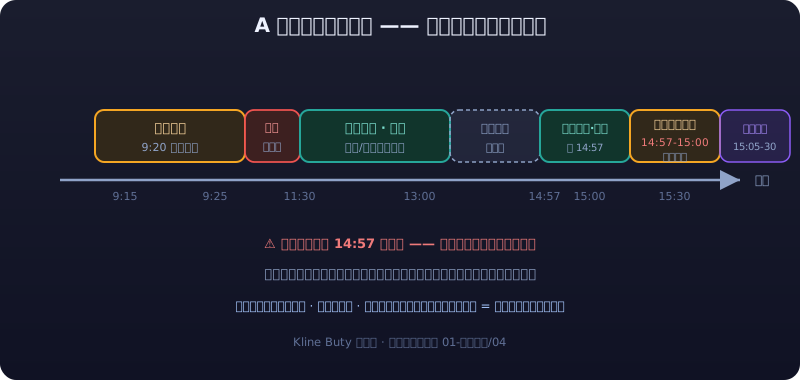
| Session | Time (Beijing) | What happens |
|---|---|---|
| Opening call auction | 9:15 - 9:25 | 9:15-9:20 orders can be placed and cancelled; 9:20-9:25 orders can be placed but cannot be cancelled |
| Pre-open pause | 9:25 - 9:30 | Opening price matched; no cancellation (SZSE accepts orders) |
| Continuous auction (morning) | 9:30 - 11:30 | Continuous matching by price priority, then time priority |
| Lunch break | 11:30 - 13:00 | Market closed; orders accepted but not matched |
| Continuous auction (afternoon) | 13:00 - 14:57 | Same as above |
| Closing call auction | 14:57 - 15:00 | No cancellation; closing price matched |
| STAR after-hours fixed price | 15:05 - 15:30 | Trades at the closing price (STAR Market) |
SSE and SZSE sessions are nearly identical; orders in the 14:57-15:00 closing call auction cannot be cancelled — finish cancelling before 14:57. No trading on weekends, public holidays, or ad-hoc exchange closures.
Key Matching Rules
| Rule | Description |
|---|---|
| Price priority | Higher buy prices and lower sell prices fill first |
| Time priority | At the same price, the order placed first fills first |
| Call-auction price | The price that maximizes traded volume — never above a buy order price, never below a sell order price |
| Market order | Types such as five-level immediate-or-cancel / best-of-five fill at the opposing side's price; slippage is possible |
T+1 and the Pseudo-T+0
What T+1 Is
| Item | A-share rule (T+1) |
|---|---|
| Shares | Bought today, sellable only the next trading day |
| Funds | Sale proceeds are usable the same day (can buy shares again), but withdrawable to the bank card only the next trading day |
| HK / US stocks | Both allow T+0 round trips (buy and sell the same day) |
Base-Position Rotation = a Legal "Pseudo-T+0"
Hold some shares of a stock first (a base position), then during the day:
① At the open, sell the base position first (lock in profit / dodge risk)
② After an intraday dip, buy the same number of shares back
Effect: sold high and bought low within the day — the share count is unchanged, the cash has grown — with no effect on your holding cost or the T+1 restriction. Known as "base-position rotation" or "doing T", it is the only legal intraday trading method for retail investors under A-shares' T+1.
"Doing T" presumes you call the base position's direction correctly; get it wrong (sell too early, or buy back dearer) and you have raised your cost instead. This is an expert's game — beginners, handle with care.
⚠️ Doing T is an expert's game; beginners beware
"Doing T" presumes you call the base position's direction correctly; get it wrong (sell too early, or buy back dearer) and you have raised your cost instead. It is the only legal intraday trading method for retail investors under A-shares' T+1, but if the direction is misjudged the round trip works against you — an expert's game; beginners beware.
Price Limits
Limits by Board (2025 figures)
| Board | Limit | Notes |
|---|---|---|
| SSE/SZSE Main Board | ±10% | Still ±10% after full registration reform |
| ChiNext / STAR | ±20% | Registration-reform boards, wider swings |
| BSE | ±30% | The widest |
| Main-board ST/*ST | ±5% | Risk-warning stocks, capped flexibility |
| STAR/ChiNext ST | ±20% | Same as the board, no step-down |
| Delisting consolidation period (main board) | ±10% | The final trading phase before delisting |
First-Day Rules for New Listings
| Board | First-day limit | Temporary halt mechanism |
|---|---|---|
| Main board (registration-based) | No price limit for the first 5 trading days | ±30% from the opening price halts until 10:00; ±60% halts until 14:57 |
| ChiNext / STAR | No price limit for the first 5 trading days | ±30%/±60% from the open each triggers a 10-minute halt |
| BSE | No limit on day one, ±30% thereafter | ±30%/±60% from the open each triggers a 10-minute halt |
| 5 days after listing | Normal board limits resume | — |
A limit-up is not "trading suspended": hitting the limit-up means buyers queue up and cannot get filled, and the limit-down means sellers cannot get out. Consecutive limit-ups usually come with elevated risk at the top — never chase boards blindly.
Minimum Trading Unit
| Rule | Description |
|---|---|
| Buying | Multiples of 100 shares (1 lot) minimum; STAR Market: 200 shares minimum with 1-share increments; BSE: 100 shares minimum with 1-share increments |
| Selling | If your holding is under 100 shares (an odd lot), you must sell it all at once — it cannot be split |
| Selling on STAR | Sell in one go when the balance falls below 200 shares |
Example: holding 150 shares, you must sell all 150 at once — you cannot sell 50 and keep 100. Odd lots mostly come from bonus/capitalization shares creating non-round holdings.
Fees
Cost Structure of One Round Trip (2025 figures)
| Fee | Charged by | Rate | Direction |
|---|---|---|---|
| Commission | Broker | Typically 0.02%-0.03%, capped at 3‰, minimum 5 CNY per trade | Both buy and sell |
| Stamp duty | State | 0.025% (sell side only) | Sell only |
| Transfer fee | CSDC | 0.001% | Both sides |
| Regulatory fees (handling + CSRC fee) | Exchange + CSRC | About 0.00541% (handling 0.00341% + CSRC fee 0.002%) | Both sides, usually included in the commission |
Stamp duty history (for reference): cut from 0.1% to 0.05% on August 28, 2023, and further to 0.025% from July 1, 2025, charged on sells only. Defer to the Ministry of Finance's latest announcement.
Worked Example on a 100,000 CNY Trade (commission at 0.025%)
| Item | Buy | Sell |
|---|---|---|
| Commission | 25 CNY | 25 CNY |
| Stamp duty | 0 | 25 CNY (100,000 × 0.025%) |
| Transfer fee | 1 CNY | 1 CNY |
| One-side total | 26 CNY | 51 CNY |
A 100,000 CNY round trip costs about 77 CNY (≈0.077%) — money already lost even if the price never moves. Commissions and taxes are the invisible killer of high-frequency trading; you can negotiate your commission down with the broker.
IPO Subscription (Market-Value Allocation)
Allocation Rules
| Item | Shanghai (main board + STAR) | Shenzhen (main board + ChiNext) |
|---|---|---|
| Market-value threshold | 10,000 CNY = 1 subscription unit | 5,000 CNY = 1 subscription unit |
| Per unit | 1,000 shares | 500 shares |
| Market value measured | Daily average over the 20 trading days before T-2 | Same as left |
| Market value portability | SSE market value can only subscribe to SSE IPOs | SZSE market value can only subscribe to SZSE IPOs |
Key Rules
- Eligibility requires the daily average market value over the 20 trading days before T-2; retail investors qualify simply by holding shares (A-share retail subscription requires no upfront payment).
- Market value is combined across multiple accounts under the same person; SSE and SZSE values are not interchangeable.
- After winning an allocation, the account must hold sufficient funds before 16:00 on T+2.
- Three unpaid wins within any 12 months bans you from IPO subscription for 6 months.
- Under full registration reform, IPOs are priced by market inquiry and breaking the issue price is the new normal (2022-2024 saw many STAR/ChiNext listings open below issue on debut), so IPO subscription is no longer "free money picked up mindlessly".
Margin Trading and Shorting
What It Is
| Service | Operation | Essence |
|---|---|---|
| Margin buying | Borrow cash from the broker to buy shares | Leveraged long |
| Margin short | Borrow shares from the broker to sell, buy back later to return | Shorting |
Eligibility (individuals)
| Condition | Requirement |
|---|---|
| Trading experience | At least 6 months of securities trading |
| Asset threshold | Daily average securities assets of ≥ 500,000 CNY over the last 20 trading days |
| Risk assessment | Level C4/C5, plus signing the risk disclosure |
Key Parameters (2025 figures)
| Parameter | Value |
|---|---|
| Margin-buying margin ratio | Minimum 80% (lowered from 100% in September 2023) |
| Margin-short margin ratio | 100% (raised from 50% in July 2024) |
| Maintenance guarantee ratio | Below 130% triggers a margin call; breaching the warning line (about 115%-130%, broker-defined) may trigger forced liquidation |
| Margin financing rate | About 5%-8% annualized, negotiable |
| Securities relending | Suspended from July 2024 (existing contracts wound down on deadline) — the supply of borrowable shares has shrunk sharply |
⚠️ Risk Warning: margin trading and shorting are leveraged borrowing of cash or shares; when prices fall, losses are amplified just the same, and breaching the maintenance guarantee ratio triggers forced liquidation (the forced close-out can land exactly where you least want to sell). The 500,000 CNY threshold itself says this is not for beginners — losing 10% in a margin account equals losing 20% of your principal.
💀 Losing 10% in a margin account = losing 20% of your principal
Losing 10% in a margin account equals losing 20% of your principal — the 500,000 CNY threshold itself says this is not for beginners. Margin trading and shorting are leveraged borrowing of cash or shares; breaching the maintenance guarantee ratio triggers forced liquidation, and the forced close-out can land exactly where you least want to sell.
Account Types
| Account | Opening threshold | Use |
|---|---|---|
| Standard cash account | None (fully online) | Trade A-shares, funds, convertible bonds |
| STAR Market access | 500,000 CNY + 24 months' experience | Stocks starting with 688 |
| ChiNext access | 100,000 CNY + 24 months' experience | Stocks starting with 300 |
| BSE access | 500,000 CNY + 24 months' experience | Stocks starting with 8 |
| Margin account | 500,000 CNY + 6 months' experience | Margin trading and shorting |
| Stock Connect access | 500,000 CNY + risk assessment | Buy Stock Connect-eligible HK stocks |
Thresholds may change; follow the broker's and the exchange's latest rules. STAR/ChiNext/BSE access is "enabled separately per account"; legacy access on old accounts is generally retained.
Northbound Funds
| Concept | Description |
|---|---|
| Northbound funds | Money flowing north from Hong Kong (including foreign capital) into A-shares via the Shanghai/Shenzhen-HK Stock Connect |
| Southbound funds | Mainland money flowing south into HK stocks via Stock Connect |
| Historical role | Once watched as the "smart money" bellwether |
| Disclosure changes | Real-time disclosure ended in May 2024; holding details became quarterly from August 2024 — the real-time "northbound net inflow" tape is history |
Bottom line: since 2024, real-time northbound data is no longer available; be wary of the timeliness of "northbound is fleeing" stories still built on old numbers. The reference value of foreign flows has also dropped sharply.
⚠️ Risk Warning
⚠️ Risk Warning
A-share rules are many and fast-changing: price limits, stamp duty, margin ratios, and the IPO mechanism can all be adjusted by regulators. Chasing limit-ups, going all-in on boards, and leveraging up with margin financing are the three big sources of retail blow-ups. Figures in this article follow the 2025-2026 rules as closely as possible; before any trade, defer to the latest announcements of the SSE/SZSE/BSE, the CSRC, and the Ministry of Finance, and to your broker app's prompts. This article is educational only and does not constitute investment advice.